

40 Years in the Stone Business: The Question Nobody Asks, and Why It Could Cost You Everything
I started as a helper in a tile shop in 1985. Worked my way up, got my own C-54 license in 1996, and eventually transitioned into fabricating and installing stone countertops full time. Forty years in this trade gives you a pretty clear view of how it works, and sometimes how it doesn’t.
In all that time, exactly one customer has ever asked me to prove we carry workers’ compensation before we started their job. Maybe four have checked to see if I was licensed.
That keeps me up at night a little. Because before you hire any stone fabricator, there is one question that matters more than the price, more than the edge profile, more than the color of the veining. And almost nobody asks it.
“Are you fully licensed, insured, and do you carry workers’ compensation on every employee who will set foot in my home?”
If the answer is anything other than a clear and immediate yes, stop right there.
The Short Version: Three Ways This Could Go Wrong Before the First Slab Is Cut
If a worker gets hurt at your house and the company that sent him there doesn’t have proper insurance, that becomes your problem. Not theirs. Yours. Your homeowner’s insurance. Your assets. Your headache.
Stone work is physically brutal. These slabs weigh hundreds of pounds and have to be muscled through your home, fit into a precise space, without breaking the stone or damaging the finished surfaces around it. That takes enormous strength in awkward, non-optimal positions. This is not a guy carrying a toolbox.
If the company touching your plumbing or gas line isn’t licensed to do that work, their insurance almost certainly won’t cover what happens next.
And if the company you hired has no real roots in your community, no reputation to protect, no reason to stay, they may simply not be there when you need them.
I’ve seen all three of these play out in real kitchens, with real homeowners. Keep reading.
“Your warranty is only as good as the company standing behind it. Make sure that company is actually going to be standing when you need them.”
This Isn’t Hypothetical
I’ve personally watched this happen five times with customers who originally came to me for a bid.
In one case, a homeowner asked me to match a competitor who was coming in a third less than my price. I told them what I always say: I know what it costs to run a legitimate operation, and that’s what I charge. They went with the lower bid. The other shop broke one of their expensive slabs during installation and asked the homeowner to pay for a replacement. When the homeowner refused, contact stopped completely. They drove to the shop to find it empty. Closed. Owner gone.
In another, a customer called me after a 20-foot raised bar, the centerpiece of their entire kitchen, was installed without proper support and was visibly sagging. They wanted us to fix it. I had to explain that touching someone else’s work opens us to liability for the entire project. To do it responsibly, we’d essentially have to remove and redo the whole kitchen at full cost. When they asked why they didn’t just call the original shop back, I learned that shop had closed right after cashing their check.
Five times in my own experience. And I’ve always wondered how many more people were too embarrassed to ever call and tell me it had happened to them.
An Injured Worker at Your Home Could Become Your Legal Problem
If an uninsured or improperly classified worker is injured at your property, your homeowner’s insurance may be on the hook. Or you may be personally liable. The contractor’s verbal assurances mean nothing in a courtroom.
Some shop owners claim their workers are exempt from coverage requirements. Some classify employees as 1099 independent contractors to avoid taxes, workers’ compensation, and benefits. California’s AB5 law has made that one of the most investigated and prosecuted misclassifications in the state. It is not a gray area. It is illegal.
Others simply fly under the radar and hope nothing goes wrong. That is their entire risk management strategy. Hope.
A judge is not interested in what the shop owner hoped or claimed. A judge looks at the facts of the injury and determines who is responsible. If the contractor can’t cover it, that question moves in your direction very quickly.
“A cash crew with a truck and a prayer isn’t just a liability risk. It’s a pretty clear signal of how that shop thinks about everything.”
You Might Save a Thousand Dollars. They Pocket Tens of Thousands. You Carry All the Risk.
When you add up California taxes, federal taxes, workers’ compensation, and paid sick leave, paying workers off the books saves a shop owner roughly 37% on labor costs. On a busy shop running multiple crews, that is tens of thousands of dollars a year quietly going into the owner’s pocket.
You might see a few hundred dollars of that in a lower bid. They keep the rest.
That is not a deal. That is a transfer of risk. You absorb the legal exposure so they can increase their margin.
Your Stone Contractor’s License Probably Doesn’t Cover Your Plumbing, Gas Line, or Electrical

Stone fabricators in California operate under a C-54 license. That license covers fabricating and installing stone surfaces. It does not cover disconnecting your sink, your stove, or any plumbing or gas line. It does not cover reconnecting them. That work legally requires a licensed plumber, electrician, or general contractor.
Some shops hold an additional license that covers this work. It’s rare. Most don’t.
If they offer full demo and reconnect as a convenience, ask to see that additional license before anyone touches anything. Most cannot produce it.
Here’s what they really don’t advertise: general liability insurance follows the scope of your license. Work performed outside that licensed scope is almost certainly not covered. So if a supply line fails, a wire shorts behind the wall, or a gas fitting isn’t seated correctly, their insurance probably won’t respond to that claim at all.
That exposure has to land somewhere. It usually lands on the homeowner.
The Best Stone Craftsmen Work Where They Are Respected, Not Where They Are Hidden
Skilled stone craftsmen have options. The ones who have spent years mastering this work and take genuine pride in what they install, they choose where they work. They don’t stay long in shops where they’re paid under the table and treated like a liability to be hidden rather than a professional to be invested in.
Real craftsmen have standards, for the work and for how they’re treated. They’ll push back if something isn’t structurally right. That’s exactly what you want in someone building a permanent feature in your home.
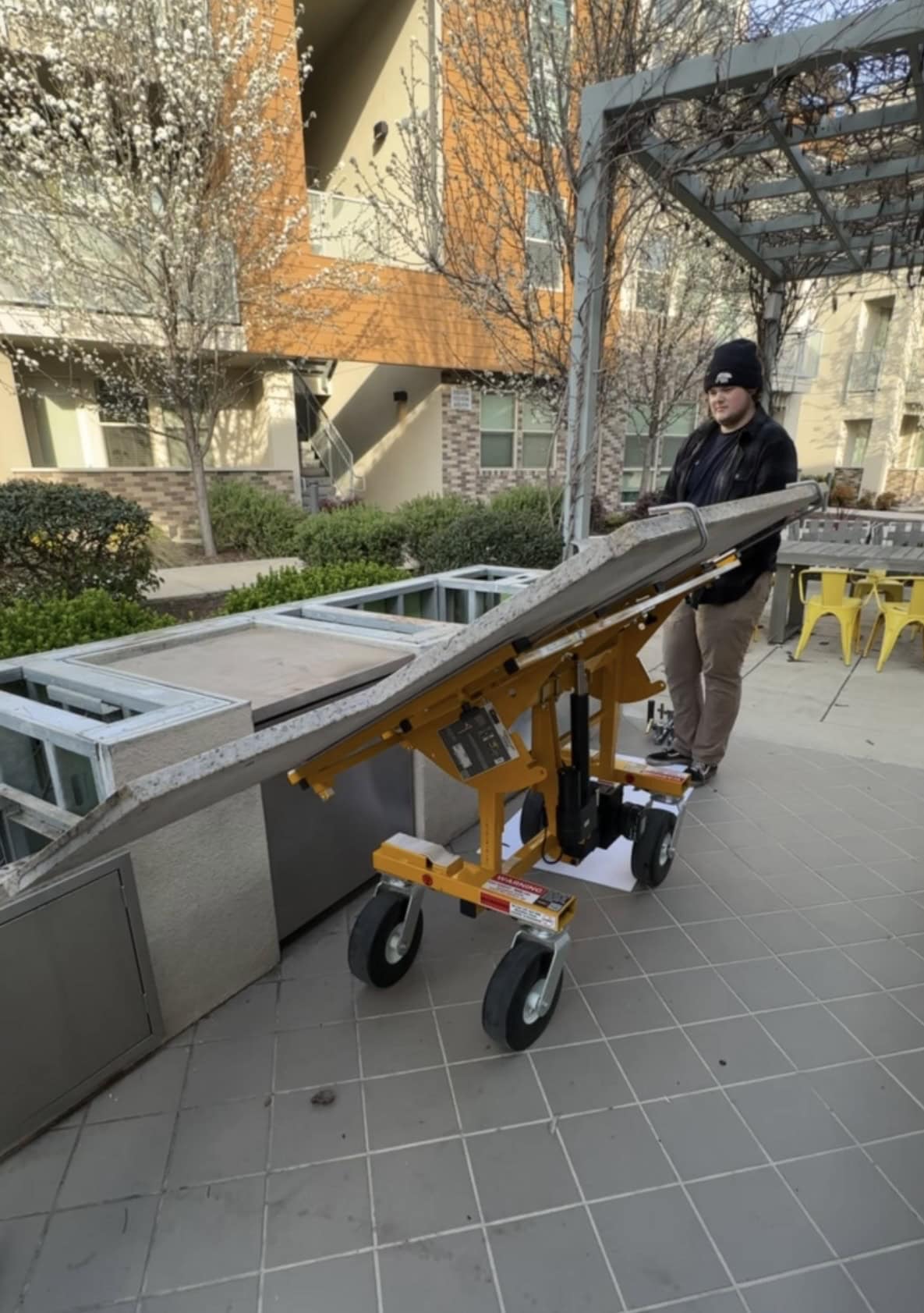
We put our money where our mouth is on this. Stone is heavy and the physical wear on a crew over years is real. We’ve invested in equipment specifically designed to move heavy stone safely, including a self-lifting cart that runs over $10,000 on its own. That’s not a small purchase. It exists because protecting the people doing this work is not negotiable.
When you hire a company that genuinely takes care of its people, you’re not just protecting yourself legally. You are far more likely to have a real craftsman standing in your kitchen than whoever was available that morning.
A Company With Roots in Your Community Has Everything to Lose If They Let You Down
A legitimate professional company is not going to do anything to hurt its customers. Their reputation, their team, and their livelihood depend on every job going right.
Over 40 years I’ve watched shops cut corners, run into trouble, close down, and quietly reopen under a new name or a new address. The accountability disappears with the old business cards. Some of these shops didn’t even start here. They arrive without a reputation, build one quickly on low prices, and when things go sideways there’s nothing holding them in place.
Community roots aren’t sentimental. They’re a financial incentive to do the job right.
When something goes wrong, who are you going to call? A company that has been part of this community for decades has an address, a reputation, and every reason to make it right. A shop that’s already closed and reopened twice has none of those things.
Your warranty is only as good as the company standing behind it. Make sure they’re still standing when you need them.
Before You Sign Anything, Ask These Four Questions
A legitimate shop answers every one of these without hesitation and backs it up with paperwork:
1. Can I see your current C-54 license number? Verify it yourself at the CSLB website. Takes two minutes and tells you a great deal.
2. Do you carry general liability insurance? Ask for a certificate naming you as an additionally insured party on your project. A legitimate shop will handle it. A shop without coverage will stall and hope you forget.
3. Do you carry workers’ compensation on all your employees? Ask for documentation, not a verbal confirmation. A legitimate shop has it ready.
4. Who is handling my plumbing and appliance reconnection, and what license covers that work? Ask to see it specifically. If they can’t produce it, you have your answer.
The shops that get uncomfortable with these questions, that deflect, get vague, or act offended that you asked, are telling you something important in that moment.
Pay attention to that.
You Deserve Straight Answers Before Anyone Touches Your Home
If you’ve made it this far, you already know the right questions to ask. You deserve a contractor who can answer every one of them without flinching.
We can. And we’ll put it in writing.
I’m Dave, owner of Innovative Stone in Auburn. I started at the bottom of this trade in 1985 and have spent four decades building something I’m genuinely proud of. We’re fully licensed under our C-54, bonded, insured, and every person on our crew is covered by workers’ compensation.
We’ve been serving Auburn, Rocklin, Roseville, Grass Valley, and the Truckee and Tahoe region since 1990. If you’re planning a countertop project and want a straight answer from someone who has seen everything this industry has to offer, give us a call.